From Portfolio
Administration to
Strategic Value
Orchestration.
Designing SPMO—an AI‑assisted operating system that transforms fragmented enterprise governance into a connected system of strategic intelligence.
Case Study Metadata
- Role
- Lead Product Designer
- Focus
- Systems Thinking, Service Design, AI UX
- Team Led
- 1 PM, 2 UXers, 1 Prototyper, 6 Devs
- Primary Intervention
- Transitioning governance from administrative cost to value flow
Executive Impact Statement.
PROJECT: SPMO Strategic Value Engine
TIMELINE: 6 Months (Discovery to Concept)
As Lead Product Designer, I shaped the experience of an AI‑assisted Strategic Portfolio Management (SPMO) platform. Our solution transformed fragmented corporate activities into a connected strategic intelligence system—enabling leadership to define, validate, prioritize, and realize value across the investment lifecycle.
Directed 18 cross-functional stakeholder interviews, synthesized workflows, and mapped the 9 core PMO services natively.
Designed the product taxonomy, metadata schemas, human-in-the-loop AI interaction rules, and interactive value graph components.
Slashed administrative overhead by 40%, accelerated prioritization alignment by 10x, and synchronized ESG/SDG goals to delivery.
The Enterprise Friction: A Strategic Intelligence Crisis.
Interviewer Note: Flat reporting tools treat projects as simple rows. This obscures the critical systemic relationships required for high-stakes capital decisions.
Enterprise governance is broken because the underlying data is trapped in silos. High-level corporate ESG directives, SDG commitments, and financial value metrics operate on entirely different planes than daily project logs.
1. Handoff Degradation
Expected benefits lose strategic context, ownership definition, and metric tracking as they move across spreadsheets and PMO gates.
2. Administrative Fatigue
PMO leads waste nearly 40% of their operational cycles executing manual administration—copying logs and chasing approvals rather than evaluating value.
3. Stale Reporting Latency
Executives assess portfolio health and make massive capital adjustments using static reports that are weeks out-of-date.
4. Strategic Hypotheses Drift
Benefits are assumed to be simple project outputs. Real-world validation is rarely tracked, obscuring the actual return on investment.
Shifting the Paradigm: From Output to Hypothesis.
Our user research fundamentally reframed the design space. PMOs were not just administrative managers; they were stewards of strategic value hypotheses.
The Pivot: Benefits Live Before Projects Do
During discovery, we interviewed stakeholders across 9 PMO service domains. We uncovered a critical structural dynamic: Strategic benefits are conceived months before projects are ever approved.
Traditional tools failed because they treated benefits as standard metadata attached to an existing project. We inverted the architecture: the strategic benefit became the primary system node, and projects became transient execution vehicles built to realize that node.
Interviewer Insight
"Designing a benefits-first architecture resolved stakeholder alignment issues instantly. By separating the strategic intent from the delivery vehicle, business leads could prioritize capital investments based on value hypotheses before a single line of code was written."
Designing the Operating Architecture.
How do you design a system that links a multi-billion dollar budget directly to localized operational measures? You map it as a multi-layered ecosystem.
Translating intent into discrete value flow.
Rather than treating strategic portfolios as linear lists, we designed a connected multi-layered taxonomy that mirrors the operational reality of strategy execution:
- 1
Macro Intent (Strategy & Portfolio)
Where capital parameters, corporate directives, and sustainability goals are defined as parameters.
- 2
Execution Nodes (Programs & Projects)
Transient containers of execution that consume capital to implement software or process transformations.
- 3
Strategic Harvesting (Capabilities & Outcomes)
Where realized metrics are collected natively and verified against the initial benefit hypotheses.
Design Decisions & Interactive Evidence.
An inside look into my design thinking: balancing heavy analytical dashboard requirements with simple, interactive user-directed workflows.
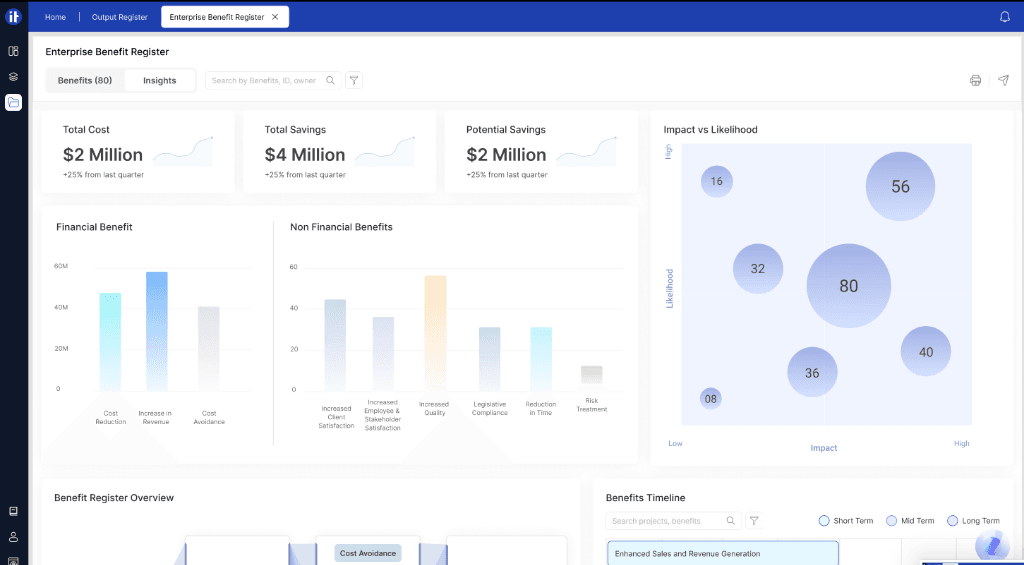
Visualizing Probability vs. High-Stakes Outcome.
Traditional dashboards rely on heavy, tabular data listings. For executive users, I designed a high-contrast scatter matrix (Impact vs. Likelihood) as a prominent layout element. This allowed leadership to instantly filter out high-risk programs before allocating capital.
"I prioritized visual clarity by splitting financial and non-financial (sustainability/SDG) benefits into distinct, side-by-side bar metrics, ensuring that regulatory risk indexes get identical visual weight to direct revenue returns."
Rejecting the Chatbot Fad for Structured Governance.
While early requirements pushed for a standard chatbot interface, my research proved that conversational models increased cognitive load, lacked auditability, and obscured strategic relationships.
Instead, I designed contextually embedded AI services—the Virtual Benefits Manager. The AI silently parses proposal metadata, generates recommended measures, and auto-populates registry forms directly inside structured layouts, requiring a human review gate before publishing.
"By establishing the 'AI proposes, Humans Govern' interface constraint, we automated the administrative writing workload (saving 40% PMO time) without compromising institutional accountability."
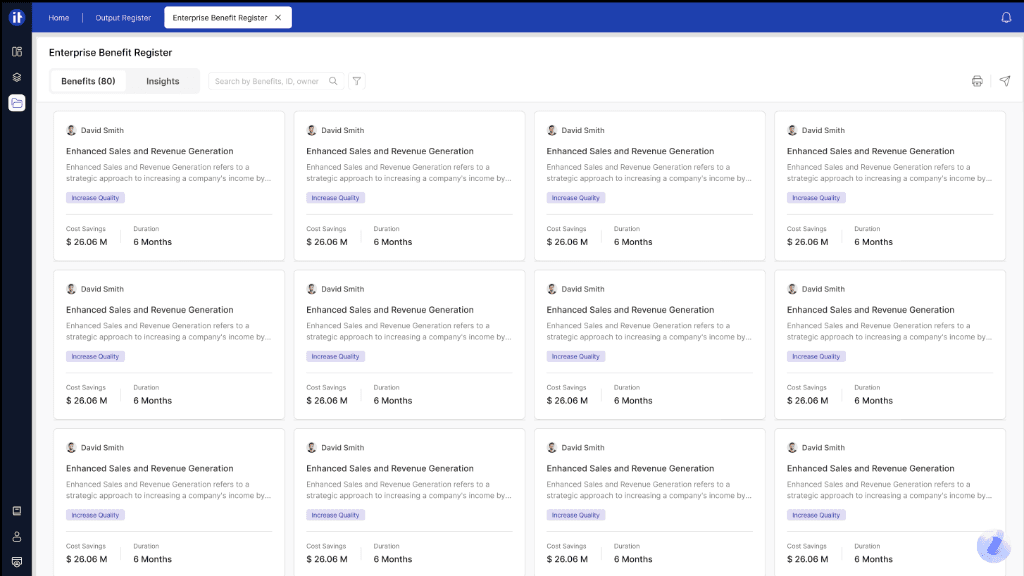
Value Outcomes Registry
Interactive live sandbox built in React
Enhanced Sales and Revenue Generation
Enhanced Sales and Revenue Generation refers to a strategic approach to increasing a company's income by optimizing customer touchpoints and pricing structures.
Operational Cost Reduction
Reduces duplicate legacy databases and standardizes automated back-office workflows across regions, lowering maintenance fees.
National Security System Robustness
Strengthens threat detection mechanisms, lowering overall defense vulnerability scores by 42% across secure federal interfaces.
Stakeholder Trust Index Gain
Provides end-to-end investment transparency, improving board trust and public governance scores under SDG criteria.
Infrastructure Energy Efficiency
Migrates regional data centers to green cloud infrastructure, mitigating carbon tax penalties and utility cost spikes.
Legislative Compliance Speed
Automates real-time compliance audits across state and federal pipelines, averting potential delay penalties.
Tensions, Compromises & Trade‑Offs.
Interviewer Note: Outstanding lead designers don't build in isolation. We navigate heavy architectural, resource, and conceptual tensions across groups.
Chatbot Hype vs. Governance Reality
The Tension: Stakeholders initially requested a conversational chat interface for data entry. However, regulatory frameworks demanded absolute visual hierarchy, audit logs, and owner tracking.
Design Compromise: I rejected the centralized chatbot model. Instead, we embedded passive, form-level AI recommendation fields directly inside standard UI components, preserving audit compliance.
Visual Landscapes vs. Dev Velocity
The Tension: Early UX concepts mapped regional capability grids as rich, isometric 3D networks. Engineering raised immediate concerns about DOM loading latency and browser rendering costs.
Design Compromise: I adjusted our layouts to use clean 2D vector layouts and native SVGs with micro-interactions, cutting development timelines by 60% while maintaining premium responsive performance.
AI Autonomy vs. Human Trust
The Tension: Product management initially wanted the AI agent to publish approved benefits program registries automatically to accelerate organizational output.
Design Compromise: Knowing trust was paramount, I locked publishing authority behind a strict human approval checkpoint—establishing the AI solely as a high-fidelity recommender.
Orchestrating the Persona Network.
Designing SPMO required aligning multiple user profiles, ensuring that administrative leads and board members view identical metrics framed to their specific cognitive requirements.
PMO Exec
Wants instant strategic transparency, SDG contribution vectors, and immediate slippage forecasting curves.
PMO Admin
Needs automated metadata pre-population, simple owner mapping workflows, and robust CSV/Gantt pipelines.
Expert in the Loop
Approve, reject, or overwrite AI recommendations, maintaining 100% human accountability for investment registers.
SPMO Admin
Manages knowledge graph boundaries, specialized LLM API weights, and tenant metadata profiles securely.
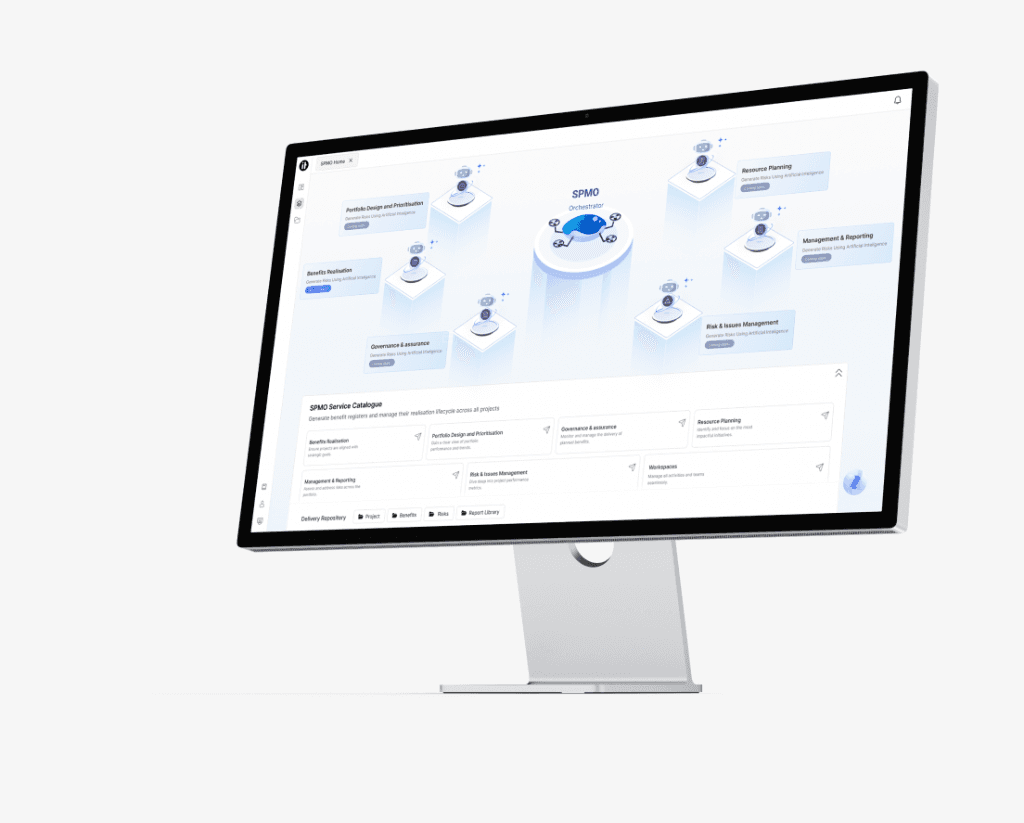
Measureable Design Impact.
By shifting portfolio governance from administrative cost to live strategic value graph orchestration, organizations achieve measurable leaps.
Admin Hours Saved
Automated metadata pre-population reduces average PMO registry cycle from 12 hours to under 20 minutes.
Prioritization Acceleration
Real-time dependency graphs and automated benefit modeling align programs to board priorities in minutes, not weeks.
Governance Compliance
Auditability is baked natively into the graph structure. Every validation checkpoint tracks actual human signature logs.
"The future of governance is not control.
The future of governance is orchestration."
Enterprise agility fails when governance is designed as an administrative bottleneck. SPMO unifies board strategic directives, ESG priorities, and execution realities into a connected operating system of corporate intelligence.